

Business Lectures

  • Home
  • About
  • My CV
  • Education
  • Learning
  • Active learning
  • Teaching
  • Teaching Tools
  • Teaching Topics
  • Teaching Methods
  • School Activities
  • Curriculum-Culture
  • Assessment - Evaluation
  • Classroom Management
  • Century Skills
  • Language Skills
  • Linguistics
  • Grammar
  • Publications-Achievements
  • Business Lectures
  • My Blog
  • Contact
  • Abouna Fanous Site


University Lectures


Meet your lecturers in Business Management


 Mr. / Girgis.   


Go to my Blog


https://mrgirgis.blogspot.com/


E-mail  1  :  girgishannaharoun@yahoo.co.uk


  E-mail    2  : girgishanna027@gmail.com


Business Studies Job Opportunities | Business Management


Click the links below to know about :


       University Business course:


Business Courses - Masterclass – House of the Reader


1- Business studies.


2- Hospitality Management.


3-Business strategy / management


4-Intenational business.


5-Marketing and consumer Behavior.


6-Economics & Public Policy.


7-Entrepreneurship and Innovation


8-Accounting and Auditing


9-Artificial Intelligence & Data 


Analytics.


10-Food & Beverage Management.


11-Event & Convention Management.


12-Finance & Investment.


13-Operations & Supply Chain.


14-Tourism & Destination Management.


15-Hotel & Resort Operation.


16-Human Resources & Leadership.


17-Human resources and Management.


18-HRM and Education.


University


Business Lectures


-------------------------------


Lecture  ( 1 )


1- Business Studies


Business Studies Made Simple Free Tutorials


Definition:


Business Studies is a practical, real-world subject

 that equips learners with the knowledge and skills

 to understand how organizations operate, grow and 

succeed. It blends finance, management, marketing, 

entrepreneurship and operations into one integrated 

discipline — making it one of the most versatile 

subjects you can study.


Whether taken at school level or through post-

school qualifications such as Business Management 

Courses and professional certifications, Business 

Studies prepares individuals to work inalmost every 

industry — from small businesses to multinational 

corporations.


What Does Business Studies Cover?


Entrepreneurship – starting and managing a business


Financial management – budgeting, cash flow and 


accounting fundamentals


Marketing principles – understanding customers, 


markets and positioning


Human resources – managing people effectively


Business operations – production, logistics and 


systems


Business law and ethics – compliance and corporate 


governance


Why Study Business Studies?


Business Studies helps learners develop essential 

workplace and life skills, including:


✔ Critical thinking


✔ Financial literacy


✔ Leadership and management skills


✔ Communication skills


✔ An entrepreneurial mindset


✔ Problem-solving ability


Many learners continue their studies after school 

throughBusiness Management Courses or professional 

certifications that build specialised business and 

leadership skills.


Career Paths


Business Studies opens doors to multiple career 

opportunities across different sectors.


Finance & Accounting


Bookkeeper


Accounting Technician


Financial Administrator


Payroll Officer


Management & Administration


Office Manager


Operations Manager


Business Administrator


Practice Manager


Marketing & Sales


Sales Manager


Marketing Coordinator


Brand Representative


Entrepreneurship


Small business owner


Business consultant


Franchise operator


Corporate & Public Sector


HR Administrator


Supply Chain Officer


Project Administrator


Because business skills are transferable, graduates 

can move between sectors such as finance, education,

 healthcare, retail, government and private enterprise.


Many professionals further strengthen their career 

prospects by completing Business Management Courses, 

which provide structured training in leadership, planning 

and organizational strategy.



What is Business Strategy? Definition, Importance, Levels, and Examples


Lecture  ( 2 )


2-Business strategy


and


management


Scaling up a business without a clear strategy is like

captaining a ship without a rudder. The success of

 any business depends on the strategy that one

 follows. The business strategy establishes the needs 

of the business. Business strategy plays an important 

role for businesses of all sizes and entrepreneurs.

 It sets the direction of the organization and helps to 

create goals to aim towards.


Business strategy


Business strategy is defined as the course of action or

set of decisions that support entrepreneurs in achieving

certain business goals. It is a master plan that outlines

the direction the organization intends to make, the

actions it will undertake, and the resources it will give

 to attain certain competitive benefits and drive

sustainable growth. It involves a combination of

decisions, actions, and resource allocation that

 positions an organization in its industry or market.


Business strategy is a long-term road-map for

achieving competitive advantage, profitability,

and growth throug deliberate choices regarding

market positioning and resource allocation.

Strategic management involves formulating

these goals and executing them through leadership, 

operational efficiency and performance monitoring.

Core components include SWOT analysis, policy 

formulation, and aligning departmental actions with 

organizational vision


What is Business Strategy?


Definition, Importance, Levels, and


Examples:


Definition


Business strategy is the battle plan for a better future.

 Scaling up a business without a clear strategy is like 

captaininga ship without a rudder. The success of any 

business depends on the strategy that one follows. The 

business strategy establishes the needs of the 

business. Business strategy plays an important role

 for businesses of all sizes and entrepreneurs. It sets 

the direction of the organization and helps to create 

goals to aim towards.


Business strategy is defined as the course of action or 

set of decisions that support entrepreneurs in achieving 

certain business goals. It is a master plan that outlines 

the direction the organization intends to make, the 

actions it will undertake, and the resources it will give

 to attain certain competitive benefits and drive 

sustainable growth. It involves a combination of 

decisions, actions, and resource allocation that 

positions an organization in its industry or market.


Why is a Business Strategy important?


Business Strategy plays a crucial role in guiding a 

firm’s growth, competitiveness, and success. It offers 

a roadmap for decision-making, resource providing,

 and adaptation to transforming circumstances, 

ensuring that the firm stays agile, focused, and well-

prepared to achieve its goals successfully. It is 

carefully planned and flexibly designed with the 

purpose of:


  • Achieving effectiveness

  • Perceiving and utilizing opportunities

  • Mobilizing resources

  • Securing an advantageous position

  • Meeting the challenges and threats

  • Directing efforts, behavior and

  • Gaining command over the situation


What is the Difference between:


Business Strategy & Business Plan & Business 


Model ?


Business Strategy, Business Plan, and Business Model

 are three distinct elements that offer various purposes

 in the world of business. They are vital for the success

 and sustainability of a business, and they are 

interconnected, with slight changes which are often 

confused by several aspiring business strategists, 

especially during their interviews


Components of :

Business Strategy & Management


Strategic Planning:


The process of defining the organization's long-term

direction, establishing SMART objectives (specific,

measurable, achievable, relevant, time-bound), and

developing plans to achieve them.


Market Analysis & Positioning:


Understanding competitors, customers, and industry

trends to identify competitive advantages.


Resource Allocation:


Efficiently directing human resources, budget, and time

toward high-impact areas to improve performance.


Risk Management:


Assessing potential challenges and implementing 

measures to mitigate them, ensuring organizational 

resilience.


Performance Metrics & Monitoring:


Utilizing KPIs (Key Performance Indicators) and

balanced scorecards to track progress and adjust

strategies


Frameworks for Strategic Management


SWOT Analysis: Evaluates internal strengths and 

weaknesses, and external opportunities and threats.


PESTLE Analysis: Examines political, economic,

social,technological, legal, and environmental

factors affecting the business.


Porter’s Five Forces: Assesses industry competitiveness

(e.g., supplier power, buyer power, competitive rivalry


Strategic Management Process


Formulation:

Setting the vision, mission, and identifying strategies 

using analytical tools.


Implementation:


Putting the strategy into action through organizational 

structure,leadership, and operational changes.


Evaluation & Control:


Monitoring results and taking corrective actions, as 

discussed in and illustrated in


Levels of Business Strategy


Effective strategic management consists of 

coordination and alignment across various levels 

of strategy to achieve the organization's long-term

 goals and competitive advantage. Business strategy 

can be categorized into different levels depending

 on its scope, focus, and the organizational hierarchy

 at which it functions.
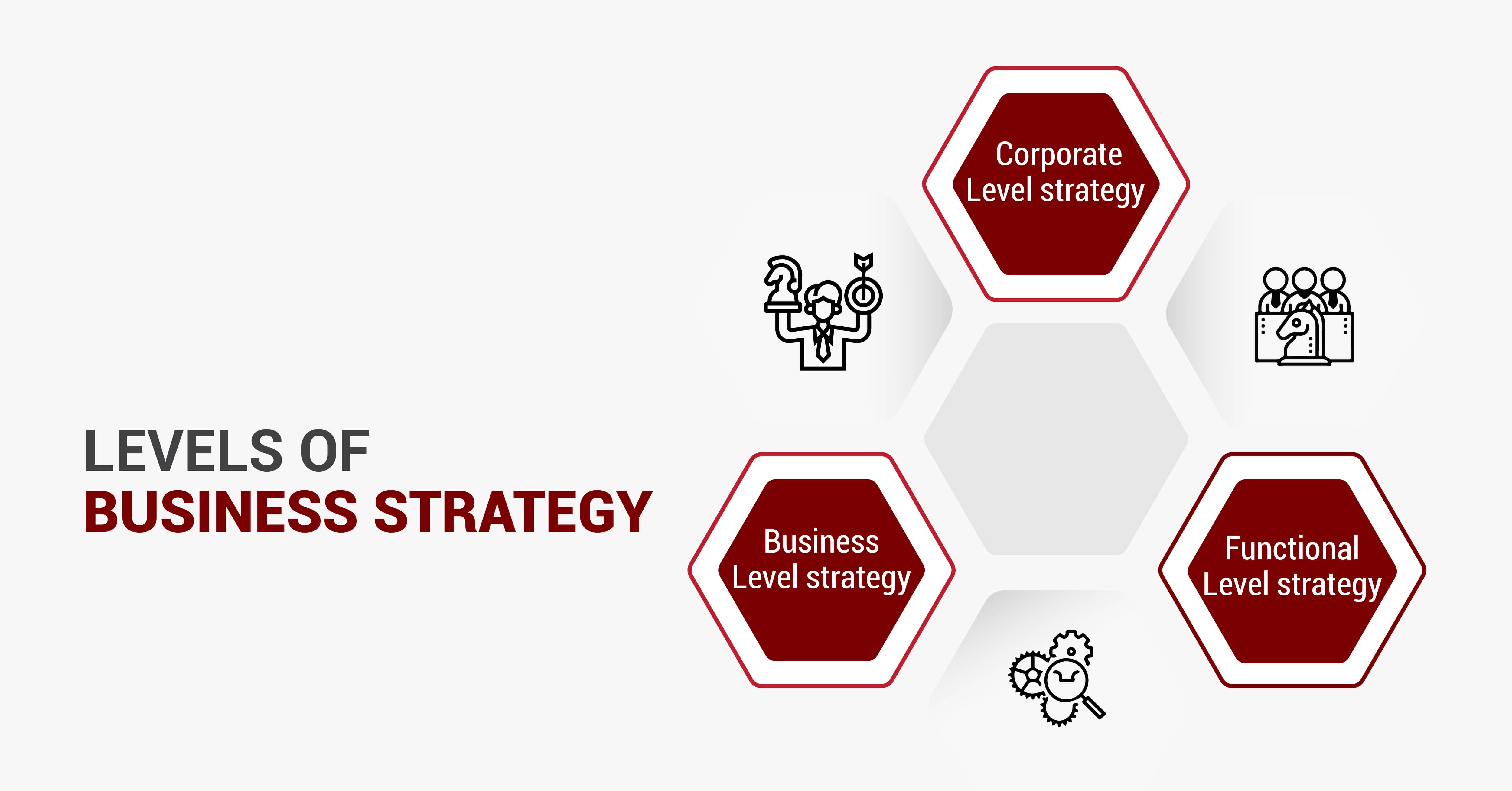


Levels of Business Strategy


 Levels of business strategy :


Corporate level strategy


Corporate level strategy is a long-range, action-

oriented, integrated, and comprehensive plan, 

which is formulated by the top management of a 

company. It is very helpful to ascertain business

 lines, expansion, growth, takeovers and mergers,

diversification, integration, and the latest fields for 

investment.


Business level strategy


The strategies that relate to a specific business are 

known as business-level strategies. It is developed

 by the general managers, who convert mission and 

vision into concrete, clear, and result-driven strategies.

 It acts like a blueprint for the total business.


Functional level strategy


Developed by the first-line managers or supervisors,

 the functional level strategy involves decision-making 

at the operational level concerning functional areas 

such as marketing, production, human resources, 

research and development, finance, and so on.


Implementing a Business Strategy


A business strategist feels that it is tough to ideate

 any plan in a few hours. It requires a step-by-step 

procedure to be associated with completing a SWOT 

analysis. Here are the top steps that can be considered 

to build the best business strategies and execute

 them with precision:


Understand the targets


One of the clearest challenges for growth is poor 

targeting. Clear target markets offer an organization

 the ability to create an integrated sales and marketing 

approach, where marketing enables sales productivity. 

Sales and marketing business plan gets executed 

more efficiently if the targets are fixed in a proper way.


Outline the tactics


A successful business strategy is made up of several 

various tactics, including both online and offline options. 

The goals, target audience, and industry factor into this

 decision. For instance, if the target audience is young, 

focusing on social media is more beneficial as this is 

primarily where this group consumes content. If the 

industry is product-based (for instance, jewelry 

designing), then using a more visual platform would 

better showcase the products. To be most effective, 

one must choose which methods are right for the 

business. Once the selection of tactics is done,

 list them in the plan and determine how they’ll help

 to reach the goals.


Think long term


In the scope of constant change, planning the horizons 

is usually shorter than it can be. However, only thinking 

quarter to quarter is a trap that may rob organizations 

of their ability to see around the bend. Best-in-class 

organizations create processes designed for a series

 of financial and non-financial metrics to treat strategy

as an annual cycle rather than a one-time, static event.


Create a timeline


Time is precious mainly when it is about the business.

Based on the goals and objectives one can set for the

business. Creating a timeline that will define what tasks

 can be completed and when they can be completed.

It is highly advisable to allocate extra time for 

unexpected events that may delay some of the goals.


Focus on growth


A thriving organization is a growing organization.

 It is only through growth that the firms can afford to 

invest in aspects such as technology, the best staff, 

and the latest tools. The business strategy should 

identify the segments where an organization will 

grow and in what proportion.


Have a budget plan


Creating a budget for the business strategy can inform

 the efforts by determining what can be done and

cannot be. Choosing the most cost-effective option

s for the business ensures the success of the overall 

business strategy. This doesn’t have to limit the 

options. Paid advertising on social media and search 

engines gives access to manage budgets well.


Make fact-based decisions


Several executives often complain about a lack of

fruitful data, but they consistently find information

that is useful in the formation of business strategy. 

The business has a set of values that guides it. 

Making fact-based decisions will outline the values 

and ensure that the people who interact with the 

business are aware of them. It will also ease the 

message that reflects on the brand honestly so it 

can actively demonstrate the values outlined in the 

mission statement through the interactions with clients.


Invest in pre-work


Always allocate time to do proper pre-work so that

 one can be up to date. It is better to conduct proper 

end-to-end research and prepare relevant information

 in advance of the business strategy meetings. The 

goals and needs will change over time. Ideally, it is 

important to revisit the business plan every annum to 

make adjustments as needed. Follow industry news 

and trends that can add to the existing strategy.


Execute well and measure results


Measuring the effectiveness of the business strategy

 will inform the current plan and future efforts.

 Always be sureto track and measure the business

so these measurements are effective. Set up a 

corporate calendar to enhance the productive 

meetings, and also to form a performance 

management cycle. One should write the marketing 

plan with this growth in mind so they can measure it. 

The execution of strategic planning needs discipline, 

and it must be taken care of by the senior executives

 to promote processes that keep the team focused.


Examples of Business Strategy


Hubspot developed and executed a perfect 

business strategy where it created a market that didn’t 

even exist – inbound marketing. It created an online 

resource guide explaining the limitations of interruption 

marketing and informing about the advantages of 

inbound marketing. The organizations even offered 

free courses to help the target audience understand

 its offering better.


Apple Inc. differentiated its Smartphone operating 

system iOS by making it simple as compared to 

Android. This differentiated it and built its followership. 

The organization has been following a similar business 

strategy for its other products as well.


Wrapping up


Establishing the business strategy keeps the business

 goals organized and focused, saving valuable time 

andmoney. With the increase in the competition, the 

demand for business strategy is becoming apparent 

and there is a tremendous increase in the types of 

business strategies used by the businesses.



AVIS Aviation Academy+91 9582896357


Lecture  ( 3 )


3- Hospitality Management.


What is hospitality management?

Hospitality management is a field of careers that 

spans experience levels and involves working at 

businesses within the hospitality industry. These 

businesses focus on providing services and 

experiences for guests, such as accommodations, 

food and beverage, travel, tourism, and entertainment.


Hospitality managementfocuses on overseeing

daily business operations, gust experiences

and profitablil;ity across industries like hotels, 

restaurants, tourism and even management.


It combines customer service with business acumen,

 requiring skills in management, marketing, and 

finance. Programs typically take 3-4 years and cover 

food service, HR, and strategic management.


Hospitality management areas


Hospitality is a broad industry that refers to any 

business offering a service or experience to customers.

 If you're interested in working in hospitality 

management, you can explore opportunities in the 

following settings:


  • Hotels and resorts


  • Restaurants


  • Bars and nightclubs


  • Cruise ships


  • Airlines and airports


  • Convention centers


  • Event venues (wedding venues, concert halls)


  • Casinos


  • Amusement parks


  • Museums and cultural Institutions


  • Stadiums and sports Arenas


  • Spas and wellness centers


  • Country clubs


  • Campgrounds and RV parks


  • Travel agencies


  • Catering companies


2026 Hospitality Management Degree Programs for Career Changers |  Research.com


Key Skills Required


Soft Skills:

High-level communication, teamwork, flexibility, and

a positive, service-oriented attitude.


Hard Skills: 

Financial management, strategic thinking, marketing,

and proficiency in technology.

 (e.g., Property Management Systems


Careers in hospitality management:


Hospitality management is not a specific level of career,

 but rather a field that encompasses various levels of 

positions, from entry-level to executive roles.


The term "hospitality management" can apply to 

differentcareer stages, depending on the job title and 

responsibilities. Let’s review the different job titles 

available to explore, depending on the hospitality focus. 


Entertainment and recreation


Entertainment and recreation facilities, such as sports 

stadiums, spas, conference centers, theme parks, 

concert venues, casinos, and theaters, all hire 

hospitality-related employees. 


Entry-level jobs can include:


Server, concession stand worker, ticket taker,

 security guard


Advanced jobs can include:


Operations manager, event coordinator, director of sales


Food and beverage


The food and beverage industry involves preparing

 and serving food and drinks to customers. It can involve 

work in restaurants, cafes, bakeries, food trucks, bars, 

breweries, wineries, or nightclubs. 


Entry-level jobs can include:


Host, server, bartender


Advanced jobs can include:


Head chef, pastry chef, sommelier


Lodging and hotel services


Hotels, resorts, and other lodging facilities are major 

employers in the hospitality industry. You ensure the 

comfort and safety of people who need a place to stay 

while they're away from home. 


Entry-level jobs can include:


Housekeeper, front desk receptionist, and reservation


 assistant


Advanced jobs can include:


Sales manager, marketing specialist, hotel manager 


Travel and tourism


If you want a hospitality job in the travel and tourism 

sector, you might work at a resort, on a cruise ship, 

or even on an airplane as a flight attendant.


Entry-level jobs can include:


Server, fitness instructor, yacht deckhand


Advanced jobs can include:


Operations manager, entertainment director,

 cruise ship director.


Bachelor of Hospitality Management - Acsenda School of Management


Hospitality management skills ?


While your exact skill set will depend on the career you

 embark on in hospitality management, strong customer

 service skills, good communication, problem-solving, 

and organization are useful in general.


Workplace skills


Because jobs in the hospitality industry focus on giving 

customers enjoyable experiences, certain people skills

 are valuable. These often include:


  • Communication


  • Time management


  • Patience


  • Teamwork


  • Ability to multitask


  • Attention to detail


  • A positive attitude


  • Problem-solving


  • Flexibility


Technical skills


The types of technical skills you'll need for a job in the 

hospitality industry depend on the particular job. 

For instance, if you have a position as a front office 

manager, you may need to be good with numbers and 

have familiarity with accounting software. For an event 

planning position, you may want to know about design,

 and as a hotel marketing manager, you will likely benefit

 from having a strong grasp of social media.


Education and Training


Degrees (Bachelor's) or certificates in hospitality

management combine theoretical knowledge with

practical, hands-on experience, often including

internships at leading hospitality group.


How to Start a Career in Hospitality Management


How to start hospitality management


There's no one way into a hospitality management

 career. Review the steps below and identify what

 seems feasible for the roles you want to pursue.

 Make sure to look at job postings to get a sense of

 what the requirements are, because that information

 can help you focus your efforts.


1. Consider a degree.


Getting started in hospitality management often requires 

a high school diploma at minimum, but a college degree, 

especially in hospitality management or a related field,

 may help you advance. Finish your bachelor's degree

 and specialize in hospitality with the University of North

 Texas' Bachelor of Applied Arts and Sciences, which features

 nine in-demand specializations.


2. Look for entry-level roles.


Start with entry-level positions in hotels, restaurants,

 or other hospitality businesses, where you can gain 

important experience and take on more responsibility.

 Work with your manager to identify ways you can 

grow or new skills you can develop so you can continue 

advancing.


3. Strengthen key skills.


Focus on enhancing communication and interpersonal skills.

 Where possible, develop your leadership and team 

management abilities, as those will become increasingly 

important as you advance. Cultivate cultural awareness 

and language skills for international hospitality, and stay 

updated with technology and tools used in the industry.


4. Explore certifications.


While certifications aren't necessary to work in hospitality 

management, they can be beneficial, showing potential 

or current employers the extra steps you've taken to 

gain or formalize your knowledge. Consider obtaining 

relevant certifications such as Certified Hospitality 

Supervisor (CHS) for entry-level supervisory positions, 

Certified Hotel Administrator (CHA) for hotel 

management professionals, Foodservice Management 

Professional (FMP) for restaurant management, or 

Certified Meeting Professional (CMP) for event planners.


5. Network and make connections.


Hospitality management is a career where getting to 

know other professionals in different settings can be 

beneficial. Join professional associations like the 

American Hotel & Lodging Association or the National 

Restaurant Association. Attend industry conferences, 

trade shows, and networking events to learn about 

trends, or engage in online forums and social media 

groups related to hospitality management.


Build customer service skills on 


Coursera


Whether you want to develop a new skill, get comfortable

 with an in-demand technology, or advance your abilities, 

keep growing with a Coursera Plus subscription. You’ll get 

access to over 10,000 flexible courses from over 350 top 

universities and companies.


View Other Resources:


1- Interaction.


2-TILO Project.


3-Active learning 1


5-Critical Thinking 1


6- Critical thinking 2


Teaching Forum

1-The TOEFL and Grammar


2-Teaching Pronunciation


3-Determining Students' Language Needs


4-Learner-Centred Teacher Education


5- Essential Concepts for Teachers


6-From da Vinci to Recumbent...


Flag Counter


Tweet

Make a free website with Yola