


Translate This Page
But as for me, I watch in hope
for the Lord, I wait for God my
Savior; my God will hear me.
American Curriculum
I am a SAT Tutor. I taught the American curriculum via SAT
Tutoring practically online to my son and daughter in Texas, USA.
-----------------------------------------------------------------
The World's Best Digital :
PSAT, SAT, ACT, & PreACT PrepTutor
Here are the main differences, with examples.
PSAT and PreACT are practice/qualifying tests;
SAT and ACT are college-admission tests. Colleges
generally accept either the SAT or ACT.
| Test | What it’s for | Main format and emphasis |
|---|---|---|
| PSAT/NMSQT | Practice for the SAT; the PSAT/NMSQT can also qualify U.S. students for National Merit recognition. | Digital, adaptive test: Reading and Writing, then Math. Similar
skills and style to the SAT, but a little shorter and generally less
challenging. |
| SAT | College admissions and, sometimes, scholarships or placement. | Digital, adaptive test: Reading and Writing, then Math. Questions often involve interpreting short passages, data, and algebra. |
| PreACT | Practice for the ACT and a way to check readiness before taking it. | Usually a paper-based practice test, though formats can vary. Covers English, Math, Reading, and Science; resembles the ACT. |
| ACT | College admissions and, sometimes, scholarships or placement. | English, Math, Reading, and an optional Science section. The standard test is primarily paper-based in the U.S., though digital options may be available. It tends to move quickly and includes more direct questions. |
Examples of how questions can differ:
Reading and Writing
SAT:
A short passage may ask which choice best completes an
argument or what a word means in context.
ACT:
A longer passage may ask about the author’s purpose,
a detail, or how a sentence should be revised.
PSAT and PreACT:
Similar question styles to their corresponding full tests,
but intended as earlier practice.
Math
SAT:
For example, solve a linear equation such as 3x+5=20,
or interpret a graph. Some questions allow a calculator and some
don’t.
ACT:
May ask a similar algebra question, but often
with more questions to
answer in less time. It also includes more
geometry and trigonometry.
Science
ACT/PreACT:
Science focuses mainly on reading graphs, tables, and experiment
descriptions—not memorizing lots of science facts.
SAT/PSAT:
Science-related information can appear in passages or data
questions, but there is no separate Science section.
In short:
Choose SAT prep for the PSAT/SAT style and
ACT prep for the PreACT/ACT style. The best test for a
student depends on which format feels more comfortable;
taking a practice SAT and ACT is a good way to compare.
Test formats and policies can change, so check the official
College Board and ACT sites for current details.

American Curriculum
Our High School program emphasizes the attainment
of sophisticated levels of skills in research, the effective
use of information, communication, and interpersonal
relationships and promotes involvement in the local and
global community. ICT plays a major role in our students’
education.
Grade: 9
This course continues the topics and skills covered in
Grade 8 and is
based on an integration of Speaking,
Listening, Reading and Writing
which will further
strengthen their communication skills in English.
Students will read the different types of literature (fiction,
non-fiction, novels, plays, poetry) to think, write and talk
about their
ideas.
Students will use grammar principles to communicate
in writing
and speaking. They will also develop their
vocabulary to promote
fluency. The course will also
show how to write a process essay in
different styles.
Grade: 10
This course uses a standards-based approach to the
study of English
containing four major quarters. Each
quarter will focus on an area of
need for the students
and their levels of need.
Students will be able to
read and analyze:
a) 1st person narratives by a variety of authors,
b) 1
novel,
c) a play by William Shakespeare, and
d) a portion of The
Canterbury Tales.
Students will have a major writing project each term,
coordinating to that term‘s reading and connecting
to real-world
applications.
Students will be able to dissect and identify the various
parts of a sentence. Student vocabulary will focus
primarily on words
used consistently by the SATs.
All four quarters are expected to weave
together
throughout the year.
Grade: 11
Eleventh grade literature will focus on building reading
comprehension,
expanding vocabulary, and sharpening
critical reasoning facilities
through an investigation
into the development of Western literature.
These skills will be honed through lessons that infuse
journal response,
essays, classroom discussion, formal
vocabulary & grammar study,
and online blogging.
As societies evolve over the centuries, the
questions
posed to, and answered, by them remain the same.
A question
such as What is an individual? What does it
mean to love? What is
freedom? What are the tensions
between an individual and society?‘ are
perennial,
but their answers evolve.
The main goal of this class to is
to learn how to use
literature, and culture, as a tool for understanding
how the answers to these questions have developed
over time.
To do this
we will study a range of novels, dramas, and
poetry from a Greek,
Medieval, Enlightenment, Victorian,
and Modern periods. When relevant,
texts will be
complemented with additional readings from history,
psychology, philosophy and sociology.
Grade 12 :
Students choose a number of subjects from grade 12,
students must also take SAT 1 (obligatory) & SAT 2
(optional).
The SAT 1 testes represent 60% of the total marks.
School diploma represents the other 40%.
All students MUST pass SAT 1 to apply for any university.
In order to apply for technical facilities i.e.: Pharmacy,
Dentistry, Medicine, Engineering, etc.., students MUST
sit for SAT 2.
The student can sit for the test at the end of G 10
as practice but test scores are counted for the student
starting G 11 & G 12. Best scores obtained are taken
for universities of the student’s choice.
English Literacy in American-Curriculum
High Schools
American-curriculum high schools typically teach English
through a combination of reading, writing, speaking, listening,
language study, and media literacy. Exact courses and books
vary by school, state, and grade.
Students commonly study:
Literature: novels, short stories, drama, poetry, and
nonfiction from a range of periods and cultures
Reading skills:
comprehension, close reading, inference, analysis,
evaluating evidence, and comparing texts
Writing:
narrative, descriptive, informative, argumentative, and
research writing
Language:
Grammar, sentence structure, vocabulary, spelling, and
academic style
Speaking and listening:
Discussions, presentations, debates, and collaborative work
Research and media literacy:
Finding and evaluating sources, citing evidence, and
analyzing digital media.
A typical progression moves from foundational reading and
writing in the lower grades to more complex literary analysis,
research, and argument in the upper grades.
Advanced courses
Advanced courses may include Honors English, Advanced
Placement (AP) English Language and Composition, or AP
English Literature and Composition.
Common textbooks and materials
There is no single national English textbook used by all
American high schools. Schools often combine an adopted
textbook or digital program with teacher-selected texts.
Materials may include:
Literature anthologies and writing handbooks
Grammar and vocabulary resources
Full-length novels, plays, poems, and nonfiction
Publishers
Examples of widely used publishers and programs include
Houghton Mifflin Harcourt, McGraw Hill, Savvas Learning,
and StudySync. The specific titles depend on the school’s
curriculum and adoption decisions.
Explicit instruction:
Teachers model reading, writing, grammar, and research
strategies
Close reading:
Students examine word choice, structure, tone, and
evidence.
Writing workshops:
students plan, draft, revise, edit, and publish
Discussion-based learning:
seminars, literature circles, and text-based discussions
Project-based learning: students create presentations,
research projects, or multimedia work
Differentiated instruction:
texts and tasks are adapted to students’ reading levels,
language needs, and learning goals
Formative assessment:
teachers use drafts, conferences, quizzes, and discussion
to guide instruction.
For a specific school, the most accurate information comes
from its course catalog, curriculum guide, or English
department.
Teaching English literacy to high school
students in an American curriculum
setting requires a structured approach.
Here are some suggestions on course content,
textbooks, methods of teaching, and how to adapt
them for online learning.
Grammar:
Focus on verb tenses, sentence structure,
and clause types.
Vocabulary:
Emphasize word meanings, synonyms, antonyms,
and idiomatic expressions.
Reading comprehension:
Include short stories, articles, and poetry to improve
critical thinking and analysis.
Writing:
Teach persuasive, narrative, and expository writing styles.
Literature:
Cover classic American works, such as Shakespeare,
Hawthorne, and Fitzgerald.
"The English Language" by George Yule (Longman) - A
comprehensive grammar textbook.
"The Norton Reader" (W.W. Norton & Company) - A
collection of literature and essays for reading and writing.
"Grammar Girl" by Mignon Fogarty (Random House) - A
grammar guide with engaging examples.
"The Bedford Handbook" (Bedford/St. Martin's) - A writing
guide for high school students.
Online discussions:
Use platforms like Google Classroom, Edmodo,
or Slack to facilitate discussions and encourage peer
interaction.
Video lectures:
Record video lessons to cover grammar, vocabulary,
and literature topics.
Interactive quizzes and games:
Utilize online tools like Kahoot, Quizlet, or Quizizz to
engage students and assess their knowledge.
Writing workshops:
Use online collaborative tools like Google Docs or
Microsoft Teams to facilitate group writing projects.
Virtual field trips:
Plan online visits to literary landmarks, museums,
or historical sites to enhance learning.
Student presentations:
Encourage students to create and share presentations
on specific topics, such as authors, genres, or literary
devices.
Peer feedback:
Use online platforms to facilitate peer review and
feedback on writing assignments.
Asynchronous learning:
Use pre-recorded video lessons, online readings,
and interactive quizzes to allow students to learn
at their own pace.
Synchronous learning:
Use video conferencing tools like Zoom, Google Meet,
or Skype to conduct live lessons, discussions,
and Q&A sessions.
Live online office hours:
Schedule regular online office hours for students
to ask questions, seek feedback, or discuss topics.
Online resources:
Share online resources, such as articles, videos,
or podcasts, to supplement course materials and
encourage independent learning.
Gamification:
Use online tools to create game-like activities and
challenges that promote engagement and motivation.
Learning Management System (LMS):
Use platforms like Canvas, Blackboard, or Moodle to
create and manage online courses.
Video conferencing tools:
Utilize Zoom, Google Meet, or Skype for live online
lessons and discussions.
Collaboration tools:
Use Google Docs, Microsoft Teams, or Slack for group
work and peer feedback.
Interactive quiz and game tools:
Employ Kahoot, Quizlet, or Quizizz to create engaging
assessments.
Online whiteboard tools:
Utilize tools like SMART Boards, Promethean,
or Google Jamboard for live online lessons and
presentations.
By incorporating these strategies and tools,
you can create an engaging and effective
online English literacy course for high school
students in an American curriculum setting.
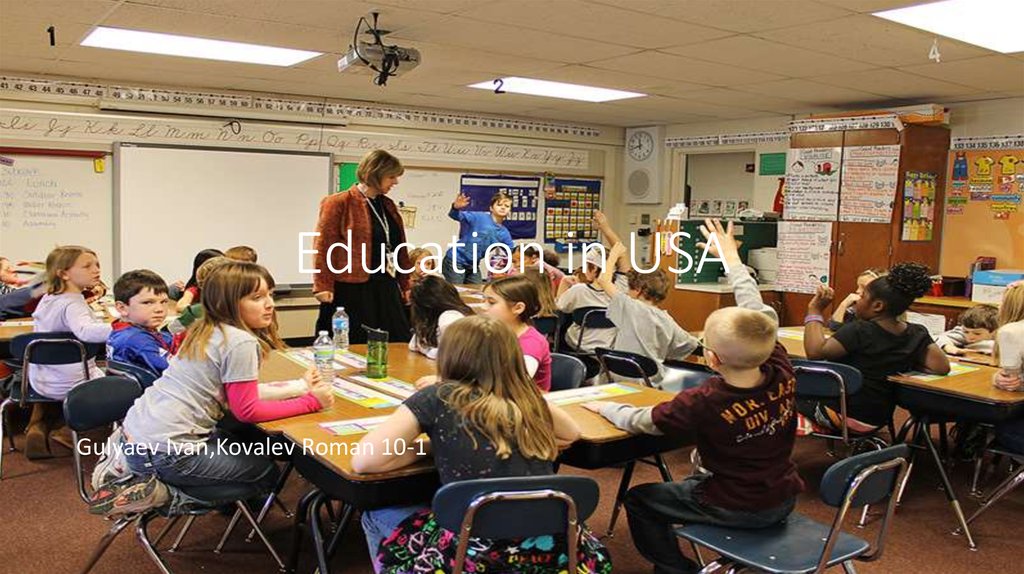
USA Educational System
The American Curriculum ( Khan Academy)
Pre-higher education:
Duration of compulsory education:
Age of entry: 6
Age of exit: 16
Structure of school system:
Pre-Primary
Type of school providing this education:
A) Kindergarten
B) Nursery Schools
C) Preschool programs;
D) Child/day Care Centers
Length of program in years: 2
Age level from: 3 to: 6
Certificate/diploma
awarded: Practice varies.
Certificates may be given, especially if needed, to
Primary
Type of school providing this education:
Elementary Schools (Grades 1-6 or 7)
Age level from: 6 to: 14
Certificate/diploma
awarded.
Middle
Type of school providing this education:
Middle
Schools
(Grades 4-6, 5-7 or 6-8)
Length of program in years: 3
Age level from: 10 to: 14
Secondary
Type of school providing this education:
High
Schools (Grades 7-12 or 8-12)
Length of program in years: 6
Age level from: 13 to: 18
Certificate/diploma
awarded
Junior Secondary
Type of school providing this education:
Junior
High Schools (Grades 7-8, 7-9 or 8-9)
Length of program in years: 3
Age level from: 13 to: 15
Certificate/diploma
awarded
Upper Secondary
Type of school providing this education:
High
Schools
Senior High Schools (Grades 9-12 or 10-12)
Length of program in years: 4
Age level from: 15 to: 18
Certificate/diploma awarded)
School education:
The age of entry to compulsory education in the
U.S. varies, according to the state, between 5
and 7 years of age, 6 being the most common.
The age at which compulsory schooling ends
varies between 16 and
18 years of age, the
most common being 16. School education does
not end until
age 18, or completion of the 12th
year of school and those who leave school at
the end of compulsory education without
earning a secondary (high school)
diploma do
not receive any certificate or recognition - they
are considered to
be secondary school drop-outs.
Secondary education
Secondary
education takes place in grades 7-12,
depending upon the laws and policies of
states
and local school districts.
Vocational
Vocational and academic/college preparatory or
honors/Regents diplomas usually have additional
set curricular requirements and/or standards
which aspiring graduates must meet or exceed.
International Baccalaureate
A growing number of public and private secondary
schools also offer the International Baccalaureate
(IB) as an optional track; completion of IB
requirements usually requires an additional
summer or semester of study beyond
the 12th year.
Higher education:
Post secondary education is broadly divided into
two
different sectors:
1-post secondary vocational education and
training, which is
non-degree but can produce
some transferable credits under certain
circumstances;
2- higher education, which includes studies
undertaken in degree-granting institutions for
Non-university level:
Educational programs corresponding to "non-
university level
technical/vocational post-
secondary studies" would include all technical
and occupational programs that lead to a
degree,diploma or certificate below
the
Bachelor's degree. Education at this level
would include:
(1) all
institutions that only award qualifications
under the Bachelor's degree;
(2)
programs leading to awards under the
Bachelor's degree offered at
institutions that
also award higher degrees.
Associate degree
The Associate degree is
the first academic or
professional degree that can be awarded in
U.S.
post-secondary education.
Holders of this degree may apply to enter higher
degree programs at the Bachelor's level, but
are not qualified to apply
directly for advanced
(graduate) studies program.
Programs of study for
this degree are usually
designed to take 2 years of full-time study, but
some
take longer to complete.
Bachelor's degree
The Bachelor's degree is
the second academic
degree that can be awarded in U.S. post-
secondary education,
and is one of two
undergraduate (first) degrees that qualify a
student to apply
to programs of advanced
(graduate) study (the other such degree is the
first-professional degree).
Programs of study for this degree are designed
to
take between 4 and 5 years, depending on
the field of study.
Honors programs
Honors programs are
offered by many
institutions that award the Bachelor's degree.
These generally
require the completion of
additional requirements such as preparation
of an
undergraduate thesis, honors paper or
project, advanced coursework, or special
examinations. .
Master's degree
The Master's degree
represents the second stage
of higher education and is the first advanced
(graduate) degree. U.S. Master's degrees may
be taught (without thesis) or research (with thesis)
and may be awarded in academic or professional
fields.
Most Master's degrees are designed to
take 2 years of full-time study
Research
Doctorate:
The Research Doctorate represents the third
and
highest stage of higher education in the
United States and may be awarded in
academic disciplines and some professional
fields of study. This degree is not
awarded by
examination or coursework only, but requires
demonstrated mastery of
the chosen subject
and the ability to conduct independent, original
research
Apply these teaching
methods:
Teaching Forum 2006, Volume
44, Number 2