


Mr. / Girgis

Curriculum evaluation
Definition
Curriculum evaluation is usually a systematic, summative
examination of all components of a curriculum that
results in evaluative conclusions, such as approval or
accreditation.
The aspects to be evaluated include the curriculum
goals, design, and outcomes, Courses, teaching and
evaluation strategies, human and physical resources
to support the curriculum, learning climate and
curriculum policies.

Purpose
Determine the strengths and weaknesses of the
curriculum.It is undertaken to establish student
achievement of the curriculum goals.
To monitor students’ learning experiences while
in the program.
Providing a basis for review, modification, and
reorganization of the curriculum.
Essentially, it is a quality control mechanism to assure
that the curriculum, its courses, the processes
undertaken, teaching strategies, and student
achievement of goals are meeting the required standards

A Curriculum Evaluation Checklist sheet
Mr. / Girgis
Here is the observation sheet
I (as a curriculum supervisor ) use to
evaluate any education curriculum :
Criteria Questions yes No Comments
Policy
1-What is the education policy?
2-What are the values?
3-Do values align with education policy?
4-What are the national education standards?
5-Are there domains, standard and indicators?
6-What is the mission?
7-Do vision and mission align with education standards?
8-What are the aims?
9-Do broader aims align with vision?
10-Does the curriculum translate goals into classroom reality
through strategic planning and stakeholders collaboration?
11-Does it provide comprehensive support (Training and
resources), continuous monitoring and adaptation?
12-Does it align national standards with local needs?
13-Does it ensure that teachers have the tools and skills to
deliver sffective instruction for student's learning?
14-Are the above criteria implemented?
15-Does the curriculum focus on values of citizenship. loyalty,
co-operation, others respect, faithfulness, share, team work,
courage, adventure, helping others,...?
Objectives
1-Are the curriculum objectives clear?
2- Do they align with the broader goals?
3-Are they measurable?
4-Are they relevant to learners' needs?
5-Does the curriculum translate broad goals into specific
measurable outcomes?
6-Does it guide teaching?
7- Does it elevate students' mastery?
8-Does it ensure a clear path from design to classroom
practice and continuous feedback for improvemen?
9-Is the curriculm student-centered?
Relevance
1-Is it relevant to real world applications?
2-Is it relevant to the learners' needs?
3-Is it relevant to the education policy
4-Is it relevant to the education standards?
5-Does it implement relevance through
a dynamic and
ongoing process that connects educational content to
students' lives, interests, and future needs in the real world?
6- Does it involve ongoing evaluation, collaboration among
stakeholders, and adaptive teaching strategies?
Learning Climate
1-Does the curriculum integrate crucial topics like climate
change education?
2-Does the curriculum allow requiring relevant, holistic
content within a positive, engaging atmosphere to foster
deep understanding and action?
3-Does the curriculum ensure that a strong climate
supports effective curriculum delivery, while a robust
curriculum addresses relevant global challenges, making
learning
meaningful and actionable for student?
Content
1- Is it up-to-date and accurate?
2-Does the curriculum cover all topics?
3-Are the materials suitable for students' level?
5-Do teachers translate curriculum into classroom practice?
6-Do teachers use varied strategies,materials, and varied
means of assessments?
7-Do the teachers center the learner and involving phases
like engaging, enacting, and embedding?
8-Does professional development bridge the gap between
design and actual learning experiences for effective student
outcomes?
Teaching aids
1-Do teachers use teaching aids?
2-Does curriculum integrate teaching aids into lesson
3-Are learners engaged with them?
4- Does curriculum use (AI)?
5-Are there plans to make abstract concepts concrete?
6-Does it boost engagement?
7-Does it cater for divese learning styles?
8-Does the teacher use appropriate audio, visual aids
or technology?
9-Are aids aligned with objectives?
10-Does the curriculum provide training and create supportive
environment for both educators and students?
11-Are aids effective for better learning outcomes?
Resources
1-Are adequate resources available?
3-Are there training materials?
4-Does the curriculum focus on adaptable resources?
5-Does it slign with standards including digital tools?
6-Does it include interactive content?
7-Does it includeprofessional development?
8-Does it move beyond memorization for future-ready learners?
9-Do materials support differentiated learning and teacher
growth?
10-Do resources include platforms like(study.com),
(UNESCO), government sites like (ed.gov.) and AI?
Human and Physical Resources.
1-Does the curriculum include physical resources like buildings
3-Does the curriculum include physical resources like materials
4- Does the curriculum utilize of these resources for successful
teaching and learning outcomes?
5-Does proper management ensure sufficient, well-maintained
human and physical resources to align with the curriculum's
aims impacting overall educational quality and student
developmen?
6-Do students practice physical excercises?
7- Does the curriculum include sprting games?
Does the curriculum include entertainment including songs,
music, acting the scenes, role-playing, quiz, riddles and
mapping?
8-Does the curriculum include health check for learners?
Methods
1-Are they effective and varied?
2-Is there a balance between theory and practice?
4-Is there a variety of teaching methods?
5-Do they implement inclusion and diversity?
6-Are they relevant to learners' needs?
7- Do they include methods like: solving problems, making
decisions, doing projects and case studies?
9-Does the curriculm include satudent-centered teaching
methods?
10-Do the methods align with students' learning styles?
11-Does the curriculum include methods of solving problems,
making decisions, doing projects, experiencing and
exploration?
12-Does it include pair work, peer work and team work?
13-Does it encourage exploration, researching and case
studies?
14-Does it encourage applicability, analysis, synthesis,
evaluation,creatation and innovation?
15-Does it include lexical approach, deduction, elicitation
and self-expression?
16-Does it include storytelling, brainstorming and talking to
technology in the form of interactive learning?
Activities
1-Is there a place to do curriculum activities?
2-Is there a place for extra-curriculum activities?
3-Do learners think, pair and share?
4-Does the curriculum include effective activities?
5-Do activities include hands-on projects, collaborative
problem-solving (like Jigsaw),concept, mapping and
cultural expression?
6-Do activities include complementing core subjects to build
deeper understanding and engagement?
7-Does the curriculum have a plan for the school activities?
8-Are activities balancing breadth (varied subjects) with
depth, using local
contexts and experiences to make learning
meaningful, and incorporating
active learning for better
retention?
Assessment
1-Is assessment aligned with the objectives?
2-Are assessments varied?
3- Is there a feedback on students' performance?
4-Is goodassessment integrated?
5-Is assessment aligned with curriculum goals?
6-Is assessment varied(formative and summative)?
7-Is assessment reliable?
8-Does it provide actionable feedback?
9-Does it guide leaning and measure progress?
10-Does it prepare students for life and higher education ?
Flexibility and adaptability
1-Is the curriculum adaptable to meet learners' needs?
2-Is there room for creativity and innovation?
3-Does curriculum balance structure with adaptability?
4-Does it focus on students needs and learning styles?
5-Does it allow teachers to modify content, pace an methods
for engagement?
6-Does it have better preparation for a changing world rather
than being rigid or outdated?
7-Does it involve personalization?
8-Does it include blended learning and universal design
for learning?
9- Does it foster students'ownership through choice?
10-Does itensure quality while adapting to disruptions
like pandemics?
Implementation
1-Is the teacher able to implement the curriculum?
2-Is there support for teachers during implementation?
3-Does the curriculum have effectiveimplementation?
4-Does it include strongleadership?
5-Does it have teacher training?
6-Does it include adequate resources(tech,materials)?
7-Does it include stakeholder involvement([arents and
community)?
8-Does it include continuous evaluation to adapt to
student needs and societal changes?
9-Does it use varied strategies like project-based learning
and technology integration?
Learning outcomes
1-Are students achieving learning outcomes?
3- Is there a place for feedback?
4-Do learners participate?
5-Do learners interact?
6-Do learners explore and research?
Continuous improvement
1-Is the curriculum reviewed for improvement
2-Are changes made based on teachers and learners'
feedback?
3-Does it have a continupus date-drive cycle of assessment?
4-Does it have feedback and revision?
5-Does it align learning wqith learners' needs?
6-Does it focus on societal change and real world skills?
7-Does it involve stakeholders collaboration(teachers,
parents, students and experts) ?
8-Does it incorporate AI and personalized learning?
Comprehensiveness
1-Are the teaching methods effective?
2-Are the learners' needs covered?
4-Does it integrate diverse learning domains (Cognitive,
social, emotional and physical)?
5-Does it offer depth and breadth through subjects?
6-Does it foster holistic development?
7-Does it foster practical application and varied teaching
strategies?
8-Does it address studemts growth?
Reliability:
1-Does the curriculum give consistent results?
2-Is thecurricul evidence-based?
4-Is it consistently evaluated?
5-Is it adapted to change?
6-Does it provide relevant knowledge and skills?
7-Does it work through standards, engaging
materials that cover diverse needs?
8-Does it show success in understanding and
Validity :
1-How well exams and quizes assess learners?
2-How well te students grasped the concepts?
3-How good are the instruments of assessment?
4-Does it acieve its intended learning outcomes?
5-Does it measure what it claims to teach?
7- Does it use emperical testing?
8-Does it prepare students for the future?
Relevance
1-Are contexts relevant to students' ages?
2-Are educational goals relevant?
3-Are national and state preiorities considered?
4-Does it providea roadmap for learnering?
6-Does it develop critical thinking and adaptability?
Efficiency
1-Are curriculum instruments measured?
2-Do instruments and resources meet the goals?
3-Does it logically structure learning?
4-Does it break down complex ideas into manageable parts?
5-Does it align with coals and standards?
6-Does it maximize students' achievement?
7-Does it have coherence, relevance and adaptabil;ity?
8-Do teachers have a clear roadmap?
9-Do students get consistent quality?
10-Does it adapt to learners' needs?
Impact
1-Does it have a positive or negative impact?
2-Does it have social, environmental and economic impact?
3-Does it set clar goals, guide teachers and engage students?
4-Does it have relevant content and diverse activities?
5-Does it foster critical thinking?
6-Does it shape academic outcomes and career readiness?
7-Does it have understanding of the world?
8-A well-designed one adapts to student needs, promotes
inclusivity, and provides a roadmap for both teaching and
personal growt
Sustainability:
1-Does it pass knowledge and ideas on from a generation
to another?
2-Does it pass values and culture on from a generation
to another?
3-Does it include knowledge, skills and values?
4-Does it empower learners to dreate better future?
5- Does it address environmental, social, and economic
challenges like climate change, poverty, and inequality?
6-Does it include critical thinking, systemic understanding,
and action-oriented learning?
7-Does it use interdisciplinary methods like "green pedagogy"
and real-world campus labs to foster responsible citizens?
8- Does it move beyond separate topics, embedding
sustainability across
subjects to build cognitive,
socio-emotional, and behavioral
competencies
for a holistic, resilient world?
Types
1-Formative evaluation
Formative evaluation is generally any evaluation that
takes place before or during the implementation of a
new project with the aim of improving the project`s
design and performance.
It is an ongoing classroom process that keeps
students and educators informed of students`
progress toward program learning objectives.
The main purpose is to provide evidence about
the feasibility and effectiveness of a portion of
the curriculum, so that ongoing revisions and
improvements can be made.
Evidence comes mainly from teachers, expertise,
supervisor, and students
Examples:
1-Judgmental data:
First type of evaluation involves judgmental data.
In that experts, teachers, supervisor, as well as student
provide opinions, judgment, reaction of the curriculum
materials: this type of evidence is gathering by rating,
questionnaires,interview.
2- Observational data:
The second type of evidence involves observational
data, which trained or untrained observers systematically
gather during teaching-learning situations in classroom
or elsewhere. This type of evidence is obtained by
direct observations in a free manner
3-Student learning:
This type of evaluation approaches the central
problems of curriculum development. What kind of
student learning take place when curriculum materials
and method are used properly. Here the main evidence
has to do with student learning that takes place in
relation to curriculum.
The best source of evidences for formative evaluation
curriculum seems to be a sort of combined use of
all of them to arrive at valid conclusions.

Benefits of formative evaluation
It identifies problems in teaching and learning and
helps to correct it.
By being formative it diagnostic weakness at an early
stage for purpose of remediation or individual teaching,
for instance, the teacher is failing to read the teacher
can quickly find remedy.
Thus keeps pupils on toes and even in the track of
progress and gives immediate feedback which is
motivating.
Formative evaluation is also ideal for future planning in
terms of changing teaching methods and pupils activities

2. Summative evaluation
:
Summative evaluation is most often undertaken at
the end of a project. As such, summative evaluation
can also be referred to as post evaluation.
The teacher uses summative evaluation to determine
what has been learned over a period of time, to
summarize student progress, and to report to
students, parents and educators on progress
relative to curriculum objectives.
The purpose is to judge the effectiveness of all
of the curriculum.Summative evaluation is also
performed to compare one curriculum with another.
Evidence comes from teachers, students, graduates,
administrators, and other stakeholders.
Benefits of summative evaluation:
It is judgmental in nature, hence it shows the worth
or the value of program.
It can be used for decision making so that the learners
can easily selected into placement streams such as
pupils are put into classes according to their test results.
It is a useful tool for guidance and counseling.
3- Diagnostic Evaluation:
It usually occurs at the beginning of the school year
or before a new unit. It identifies students who lack
prerequisite knowledge, understanding or skills.
Diagnostic testing also identifies student interests.
Diagnostic evaluation provides information essential
to teachers in designing appropriate programs for all
students.
Usually analysis of this evaluation occurs when:
1. Content of curriculum is updated
2. Something is added
3. Something is taken out
Evidence comes from teachers and administrators.
Benefits of diagnostic evaluation:
It is helper in solving problems of students.
It is helper in make teacher`s performance better.
It is helper in encourage students and teachers.
It is helper in educational plans.
Models for Curriculum Evaluation
There are several models available for curriculum
evaluation. Let's take a close look at a few of these
models.
A-The Tyler Model
This model is often referred to as objective model,
because it`s objective approach to educational
evaluation.
It emphasizes consistency among objectives, learning
experiences, and outcomes.
Curriculum objectives indicate both behavior to be
developed and area of content to be applied.
Tyler recommends that curriculum planners identify
general objectives by gathering data from
Three sources:
1- The learner
2- Contemporary life outside the school
3- Subject matter
From this model there are four basic questions:
What is the purpose of the education? (Objectives).
What educational experiences will attain the purposes
(instructional strategies and content).
How can these experiences can be effectively organized?
(Organization of learning experiences).
How can we determine when the purposes are met?
(Assessment and evaluation).
Stating objectives:
The progressive emphasizes the importance of
studying the child to find out what kinds of interests
he has, what problems he encounters, what purposes
he has in mind. The progressive sees this information
as providing the basic source for selecting objectives.
Selecting learning experiences:
Tyler believes that students learn through exploration.
Tyler believes teachers should encourage children to
become actively engaged in discovering what the
world is like.
Organizing learning experiences:
Central to Tyler`s model is effectively organizing the
learning activities.
Students need concrete experiences to which the
readings are meaningful connected.
Three major criteria are required in building organized
learning experiences: continuity, sequence and
integration.
Evaluating the curriculum:
The process of assessment is critical to Tyler`s model
and begins with the objectives of the educational
program.
The process of evaluation is essentially the process
of determining to what extent the educational
objectives are actually being realized by the
program of curriculum and instruction.
Strengths of model:
Involve the active participation of learner.
Educational objectives are clearly defined.
Simple linear approach to development of behavioral
objectives.
Criticism of Tyler model:
Narrowly interpreted objectives (acceptable verbs).
Difficult and time consuming construction of behavioral
objectives.
Curriculum restricted to a constricted range of students
skills and knowledge.
The teacher can control the learning experiences
through the manipulation of the environment,
which results in stimulating situations sufficient
to evoke the kind of learning outcomes desired,
B-The Taba Model
Hilda Taba created a model for curriculum evaluation
based on her desire to emphasize inductive reasoning
and her belief that true curriculum should be developed
by the teacher, rather than decided upon by
administration or another authority.
Taba advocate an inductive approach to curriculum
development. In this approach, curriculum workers
start with the specifies and build up to general
design as opposed to the more traditional deductive
model approach of starting with the general design
and working down to the specifics.
There are seven stages in the Taba Model, also called
the ''Inductive Approach,'', which can be applied
in both the development and evaluation of curriculum.
1. Diagnosis of needs
2. Formulation of objectives
3. Selection of content
4. Organization of content
5. Selection of learning experiences and activities
6. Organization of learning experiences and activities
7. Determination of what to evaluate and the ways
and means of doing it.
Problems from using the Taba model are:
1-Teachers not understanding the connection
between the content, activities, teaching
methods and evaluation.
2-Keeping the resources up to date.
3-Maintaining training for new teachers on the method
as well as support needed for teachers as they must
review the plan often
C-Stake's Model
(Countenance Model)
Robert Stake formulated the Countenance Model in
the 1960s. His model looks at curriculum from a more
scientific point of view by examining three distinct
areas of the curriculum:
Antecedents.
The conditions existing before implementation.
of the curriculum.
Transactions.
.
The activities and experiences
occurring during implementation
Outcomes
The results and changes brought about after
implementation of the program.
Describe the program fully
Judge the outcomes against external standards
D-CIPP Evaluation model (Stufflebeam)
CIPP model was originated by Daniel Stufflebeam and
Egon Guba. According to Stufflebeam, evaluation is the
process of delineating, obtaining, and providing useful
information for judging decision alternatives.
Delineating refers to focusing of informative requirements
needed by decision maker
Obtaining implies collection, organization and
analysis of information
Providing refers to synthesizing of information
Delineating and providing operations are carried out
collaboratively between evaluator and decision maker,
whereas the obtaining of information is carried out
primarily by the evaluator.
Components of CIPP model:
Context Evaluation: Planning decisions
Needs to be address? Existing programs?
Input Evaluation: Structuring decisions
Available resources, alternative strategies?
Process Evaluation:
Implementing decisions.
How well isplan being implemented?
Barriers to success?
Revisions needed?
Product Evaluation:
Recycling decisions. Results?
Needs reduced?
What to do after program has run its course?"
Components of curriculum evaluation:
1. Curriculum Goal
.
2. Curriculum Design
.
3. Teaching Strategies.
.
2. Curriculum Design
.
3. Teaching Strategies.
4. Courses.
5. Human and Physical Resources.
6. Learning Climate.
7. Education Policies.
8. Learning Outcomes.
Planning Curriculum Evaluation:
Planning curriculum evaluation is a dimension of
curriculum development that should occur
simultaneously with curriculum and course design.
Curriculum evaluation is only one aspect of a school’s
activities and decisions are made about:
Purposes to be achieved by curriculum evaluation
(why and for whom it is necessary).
Individual or committee responsible for overseeing
the curriculum evaluation.
Relevant data.
Methods and timing of data collection.
Individuals who will interpret and judge the evidence.
Establishing Standards, Criteria, and Indicators:
Decisions about curriculum effectiveness and quality
depend on a clear understanding of the standards
against which the curriculum is being judged and the
criteria whose achievement show that the standards
are being attained.
Definitions:
Standard is a predetermined level of excellence
that serves as a guide for practice.
Standards are written statements that define an
excellence level of performance or a set of conditions
determined to be acceptable by some authorities
Criteria are statements which identify the
variables that need to be examined in evaluation
of a standard”.
The indicators that point to achievement of the
standards may be appropriate. As well, agreement
must be reached about whether the standards are
absolute or relative.
(NB)
The standards, criteria, and indicators must be
specific enough to be understandable and provide
direction for data collection and evaluative judgments,
while not being too extensive and detailed.
Planning Data Collection
The standards, criteria, and indicators that have been
formulated determine which data are necessary for
curriculum evaluation.
The same data might also provide evidence of the
effectiveness of several aspects of the curriculum.
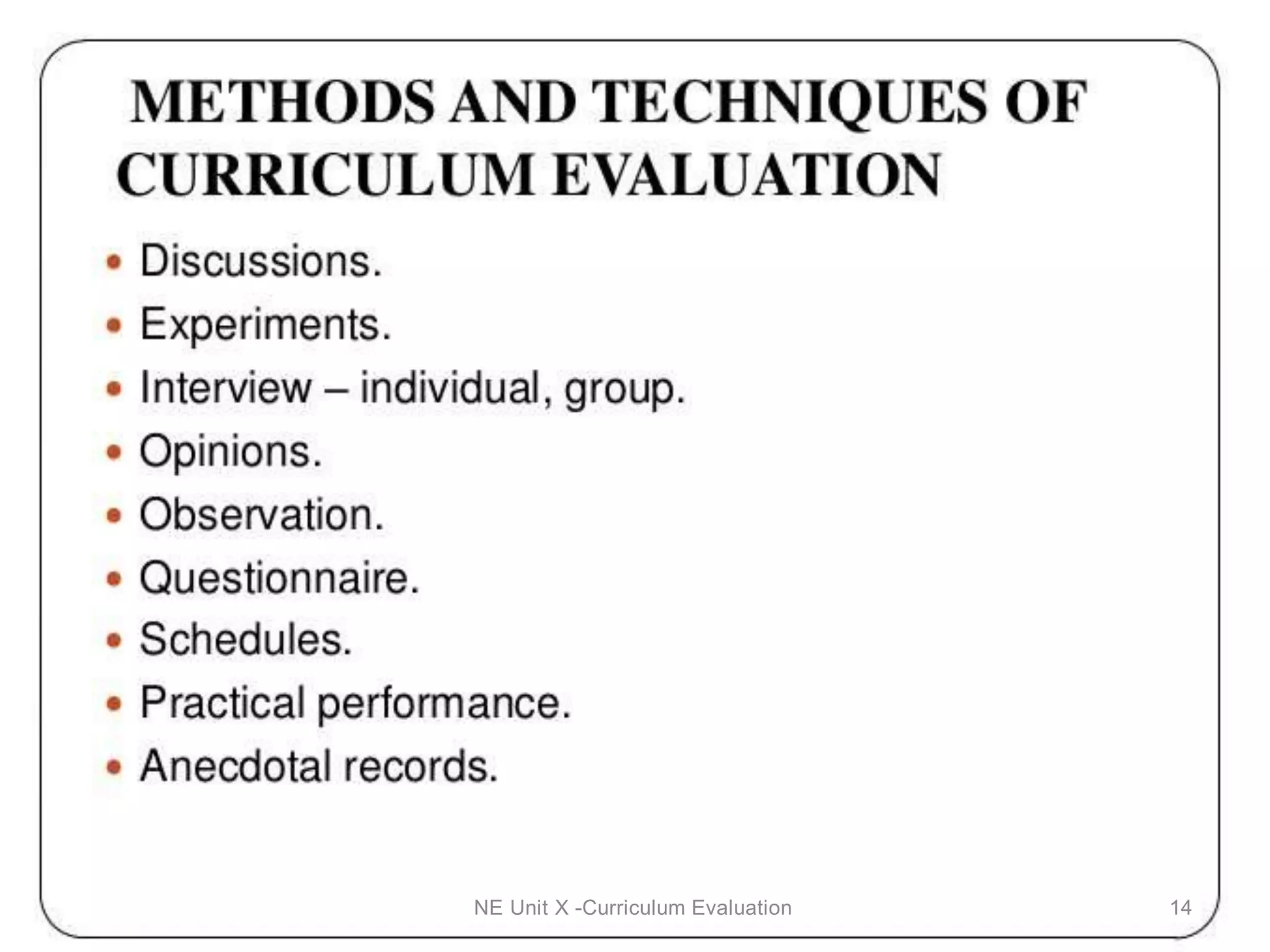
Data Collection Methods:
Typically, both qualitative and quantitative data are
obtained. The methods and tools should allow for
a comprehensive evaluation, be understandable
and easy to use, cost and time efficient, valid and
reliable (if quantitative), and credible (if qualitative).
1. Surveys:
Can be used to assess:
Teachers’ and students’ level of confidence or
satisfaction with the curriculum,
Their views about specific teaching strategies
2. Interviews
(individual or focus-groups):
Can reveal quantitative or qualitative data from
students, faculty or graduates for similar purposes.
3. Unstructured observations:
Can be useful early in the evaluation process from
which, structured observation based on criteria can
be planned. For example, observations of students
in the clinical area can lead to the acquisition of
more specific data about students’ clinical abilities.
4. Checklists, and self-reports:
Are other means of obtaining data for curriculum
evaluation.
Rating scales could be used to measure abstract
concepts, while checklists can identify expected
behaviors or competencies and related student
performance.
Data Sources:
Data sources include faculty, students, administrators,
nurses, and nursing leaders, as well as curriculum
and course documents.
Student essays, journals, and other assignments
can provide valuable insights about their knowledge,
attitudes, and experiences.
Scheduling Data Collection:
The timing of data collection is important. It should
begin with the first courses so that formative
evaluation is undertaken concurrently with curriculum
implementation. In this way, early decisions arising
from formative evaluation can stabilize the curriculum
and prevent problems that might occur in courses
yet to be implemented.
Data Management and Reporting:
It is vital that a decision be made about who will
have responsibility for data collection, compilation,
interpretation, and formulation of judgments.
Additionally, there should be consideration of
a system to store data and record evaluation
deliberations.